What two recent AI events tell us about Manufacturing AI

This month, our team attended two AI events — Ai4 and AIMST — and a few common threads ran through both. Manufacturers today sit across a broad AI maturity curve: some worry they're being left behind and don't know where to start, others are running isolated pilots with narrow use cases, and a small number have reached fully integrated, agentic operations. Across the board, it was clear that the value of manufacturing-specific AI solutions resonated with everyone.
So what separates the organizations getting real results from everyone else? They're using purpose-built AI tools trained on manufacturing and connected asset data. Without that industry foundation and the specialized workflows built around it, generic off-the-shelf models struggle to deliver on the use cases that matter most to their operations.
Ai4: The case for industry-specific solutions
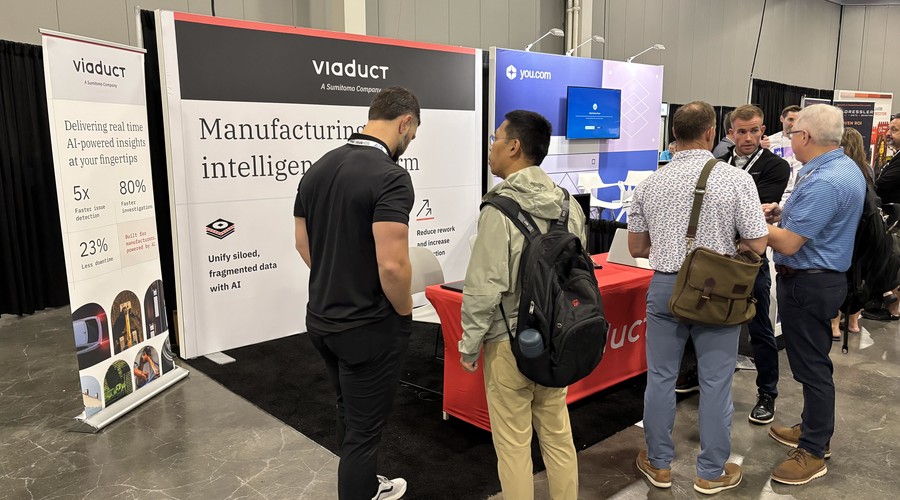
What we heard consistently at the event, especially at our booth, was real interest in industry-specific AI — and attendees were glad to see Viaduct represented. A common theme in those conversations was the importance of understanding the entire manufacturing lifecycle. One attendee put it simply: "It's great to find an AI company that understands our type of manufacturing and the quality challenges we face."
David Hallac, Viaduct's founder and CEO, joined the Smarter, Faster, Leaner: AI in Modern Manufacturing panel, which focused on how leading manufacturers are using AI to boost productivity and resilience.
Asked what a successful AI implementation actually looks like, David pointed to Viaduct's work with Sumitomo Rubber Industries (SRI), which owns Dunlop and Falken Tires along with athletic brands such as Dunlop Sport, Srixon, and Cleveland Golf.
SRI produces over 124 million tires annually, and its Miyazaki plant — one of the company's largest facilities — manages machine maintenance issues daily. In just 3.5 months, Miyazaki stood up a unified data foundation, gained real-time operational visibility, and launched AI-powered repair guidance, cutting repair time by 45% and monthly analysis time by 80%. Having proven the model on a specific use case, SRI is now looking to replicate it at scale, with Miyazaki serving as the blueprint for its global plant operations.
Sumitomo's results show what's possible when purpose-built AI solutions are deployed in a manufacturing environment.
AIMST: Getting to predictive with equipment maintenance
At AIMST, I joined the AI-Enabled Continuous Improvement & Operational Excellence in Industrial Operations panel, which examined the decisions that will shape manufacturing over the next decade. A few themes stood out.
First, trust has to be established upfront. The people who have been running manufacturing operations for years need to be part of the process and need to be heard. Many plant workers have decades of experience, and executing these processes still depends on that knowledge. That's why human-in-the-loop architecture matters — it's about putting better tools in experienced people's hands, not replacing them.
Second, most organizations are still reactive, but they don't have to jump straight from reactive to predictive. The first step is becoming proactive: understanding what is actually causing issues inside their operations and identifying the leading indicators that signal problems before they escalate. That alone is a meaningful improvement over how most decisions get made today.
Nowhere was the gap between reactive and predictive clearer than around equipment downtime, which came up more than any other topic at the event. Manufacturers want end-to-end visibility into equipment health — insight into when something is likely to fail, and clear repair guidance when it does. The question has shifted from "can we use AI" to "we need to know before it breaks."
The common thread
Both events reinforced how differently organizations are progressing. Some need guidance on which data sets to prioritize in building a foundation; others are past that and need help identifying which use cases to apply AI to first.
What's clear is that organizations are hungry for answers — not just on where to start, but on what success looks like. The best path forward is partnering with an industry-specific provider who understands the workflows, the challenges, and the KPIs that define success.
Learn more about Viaduct's approach at www.viaduct.ai/for-manufacturing.