From Data Overload to Operational Clarity: Key Takeaways from Our IndustryWeek Webchat

In our recent IndustryWeek webchat, I sat down with their Senior Editor Dennis Scimeca to discuss the challenge nearly every plant leader is wrestling with: how do you turn fragmented, siloed data into a strategic asset that improves throughput, quality, and asset performance?
If you missed the live session, here's a recap of the conversation, the questions we answered, and the real-world results manufacturers are already seeing.
The problem of data everywhere, answers nowhere
Every plant generates massive amounts of data so the problem isn't a lack of data, it's that it lives in disconnected systems, making even basic questions surprisingly hard to answer:
- "What's causing so many defects at my plant?"
- "How do I know when my equipment is going to fail?"
Without a unified view, these questions turn into weeks of manual, trial-and-error troubleshooting. The result: the same failures keep repeating and getting ahead of them is nearly impossible.
We polled our live audience, asking them their biggest data challenges today and overwhelmingly they responded with “Spending too much time manually piecing data together.”
Other challenges that consistently come up include:
- Data siloed across multiple systems/organizations
- Inability to make real-time decisions
- Too many data quality issues
This tracks with what we see across the industry every day. The barrier isn't a lack of data, it's the inability to create a unified view.
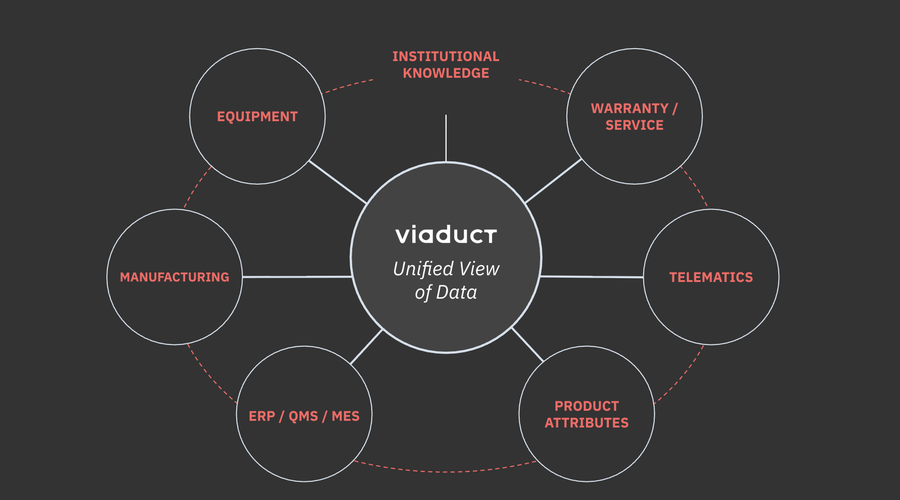
A true unified view pulls together every data type — structured and unstructured — into one place. Most organizations already have the data they need; the hard part is bringing it together.
One often-overlooked data source is an organization’s institutional knowledge. This is the expertise sitting in your employees' heads which is never documented, not accessible, and at risk of walking out the door when employees leave the company. We believe this is the highest-value and most critical data source that should be incorporated into your environment.
Once all of your data is unified, organizations can leverage AI to start driving value.
Where AI actually moves the needle
While every conversation today seems to be about AI, I would caution against thinking all AI is the same. General-purpose models weren't built for manufacturing, and it shows.
For AI to drive value in manufacturing, it needs to be purpose-built and trained specifically on manufacturing and connected asset data. Without that grounding, it simply can't solve the use cases that matter most to your operations.
Ideally, AI is deployed on top of a unified data foundation but they don’t have to be sequential efforts. Both efforts can and should move forward in parallel because you will start seeing value.
During the webchat, I shared two customer examples of what’s possible when you combine a strong data foundation and purpose built AI:
Example 1: Decreasing equipment downtime
Sumitomo Rubber Industries (SRI) produces over 124 million tires a year. At its Miyazaki plant, one of its largest, any disruption ripples immediately across production. Technicians were troubleshooting equipment issues one by one, through a slow trial-and-error process that made it nearly impossible to get ahead of maintenance problems. Legacy systems and manual processes were a big part of why they couldn’t scale their operations or track equipment performance.
By leveraging Viaduct, SRI reduced repair time by 45% and decreased monthly analysis time by 80%.
Example 2: Reducing defects
A leading manufacturer couldn't keep up with customer demand due to high defect rates with each vehicle, requiring hours of rework. Making matters worse, the quality team was spending five hours a week per person just on manual reporting before root cause investigation could even begin.
Turning to Viaduct to unify their data and leverage AI to surface emerging defect patterns early, the team saw a 50% increase with First Pass Yield and a 30% reduction in defects per unit.
Three takeaways
Unifying your data and deploying AI across an entire operation can feel overwhelming. That’s why organizations that are making the most progress don't try to transform everything at once. Our recommendation is to start with practical, high-impact operational problems that create measurable value early, then scale from there.
As you think about your journey, keep in mind these three considerations:
- Build a strong data foundation. Unify all of your data, including institutional knowledge, into one view.
- Leverage AI purpose-built for manufacturing. General models are not built to solve manufacturing use cases; leverage models trained on manufacturing and connected asset data.
- Choose partners who know manufacturing. Domain expertise matters as much as the technology itself.
To watch the recording, click here. Want to learn more or see a demo of Viaduct? Reach out to me at jim@viaduct.ai.