Smart Groups: Binning messy data that leads to fixing quality issues faster

Quality issues are a huge burden for manufacturers, but the good news is that the data to catch these issues already exists. Making sense of it is the hard part. The data is messy and fragmented and it’s spread across multiple sources, such as technician notes, Excel files, warranty claims, and service logs. This results in the same problem being described in many different ways across thousands of records while the most important details are buried in individual records. Emerging issues go unnoticed, and it’s hard to see what’s actually happening.
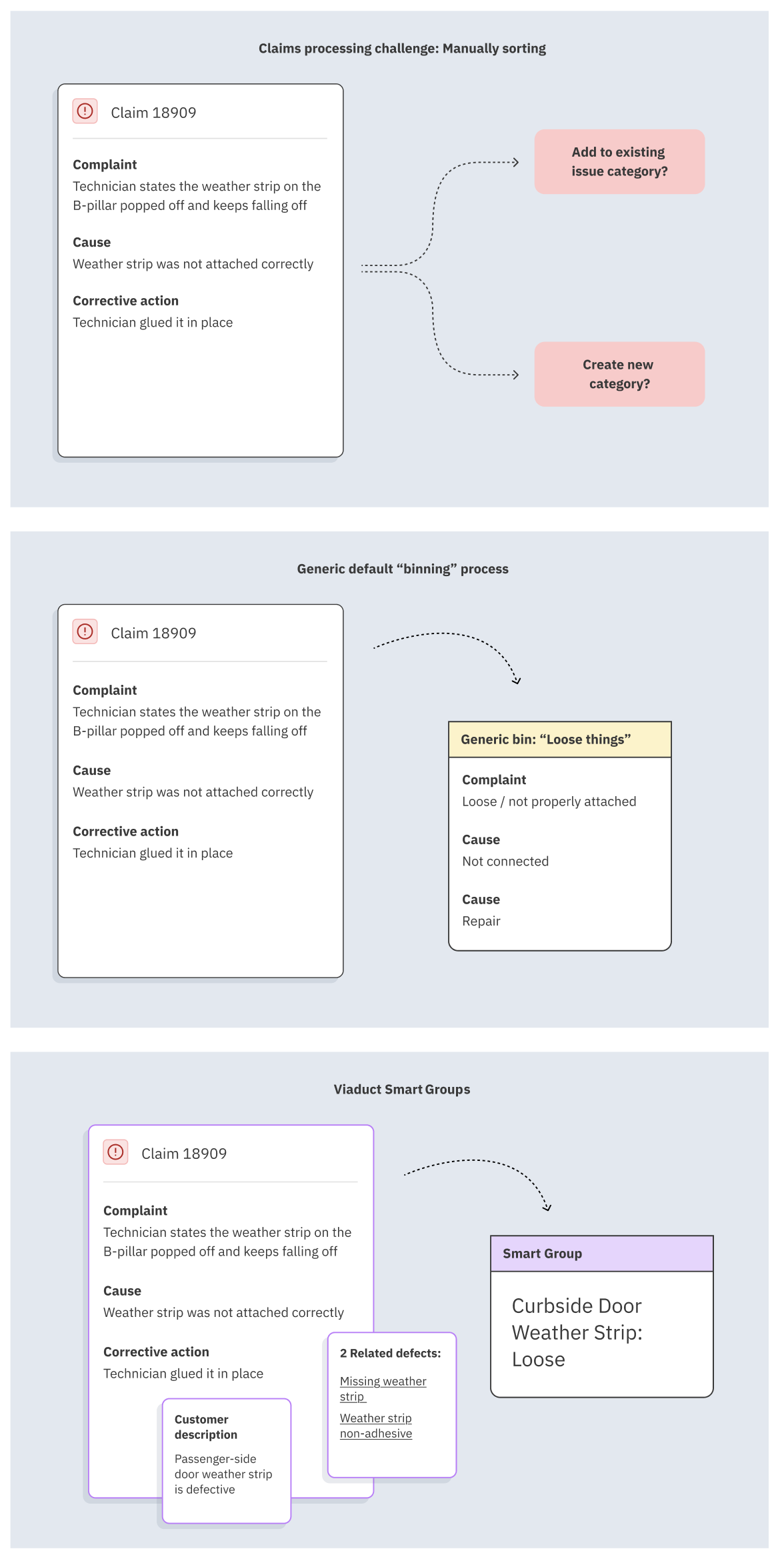
Systems alone can’t fix the problem. It’s about how issues get binned. Most quality systems bin issues using a fixed set of categories, such as affected component, defect type, or repair.
But when a new issue surfaces and there's no category for it, people pick the closest one, even if it's wrong. The issue gets buried because the notes say one thing and the category describes another.
Manual re-binning issues can easily take 1–2 hours of someone’s day. It’s slow, it doesn’t scale, and it’s prone to error. Even more importantly, it pulls your most experienced people away from actually fixing problems.
Not doing it means issues continue to go unnoticed, the problem compounds and becomes a costly problem to the business.
That’s why Viaduct built Smart Groups. Manufacturers shouldn’t need to spend hours on manual binning and analysis to understand what went wrong. Smart Groups uncover issues as they emerge so teams can act before they turn into costly problems.
How it works
Smart Groups interprets every event the way it was meant to be captured by combining structured data with technicians’ notes. Events that describe the same problem get automatically added into the same group.
Below is an example of how three technicians might describe the same event - a battery failure due to overcharging - three different ways:
- "ALT overchg 15.9V, batt case swollen"
- "VR failed high, boiled batt dry"
- "cust smells rotten eggs, chg sys output too high → repl alternator + battery"
Smart Groups captures these entries and recognizes that they describe the same event.
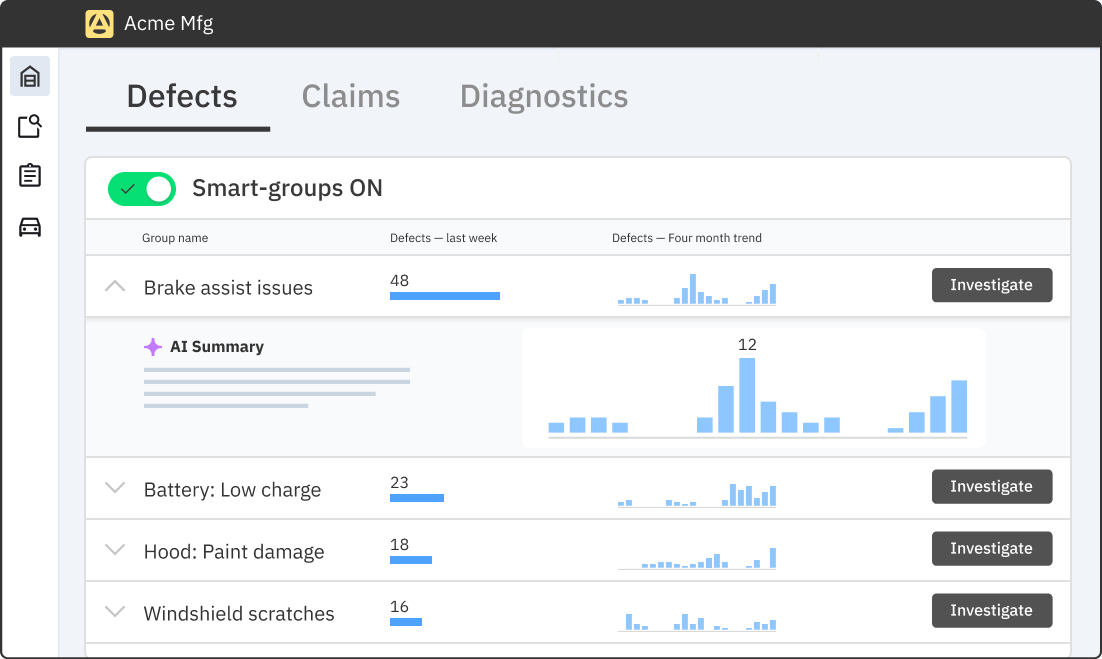
As a new pattern forms, groups are created in real-time and teams can track them immediately. Teams can filter the groups by time period and by any event type to see which issues are new and how they are trending.
What makes Smart Groups…“smart”
They work with any type of event data. While plant defects and field claims have the greatest impact on manufacturing operations, any event data can be grouped together.
They are customizable. Teams have the flexibility to modify Smart Groups and create rules like "treat door latch and door handle problems as one group."
They handle messy data. Our technology can interpret shorthand, typos, and missing details to automatically group similar events.
Four ways manufacturers benefit from Smart Groups
- Catch emerging issues early. A new smart group appears as soon as a new pattern emerges.
- Trace a claim back to what caused it. Grouping claims with upstream defect data uncovers the underlying issue and how to fix it.
- Close the loop on root cause. A Smart Group can be turned into an investigation that can be tracked and monitored in one place.
- Track and update countermeasures. After a fix, smart groups automatically track progress on the issue so you don’t have to. If a countermeasure stops working, you will be alerted.
What can you uncover with Smart Groups?
There are so many applications for Smart Groups. How about using it to uncover parts that keep slowing down production so teams can act before they become a bottleneck? Or connecting Smart Groups to the FMEA to flag failures the FMEA isn’t tracking?
Want to see which issues are hiding in your own data? Book a demo with Viaduct.